
Body Fat Calculator
Two people can weigh exactly the same and carry completely different amounts of fat. That is the gap body fat percentage fills. This calculator uses the US Navy tape method: three quick measurements with a tailor’s tape, and you get your fat percentage, your fat mass and your lean mass, plus a physiotherapist’s read on what to do with them. If you have only checked the scale so far, run our BMI calculator for the screening number first, then come back here for the story behind it.

Your result
The US Navy equations, shown in full below. Nothing you type leaves this page.
How to measure for the Navy method
The whole method stands or falls on three tape measurements, so take two minutes and take them properly. You need a soft tailor’s tape, light clothing or bare skin, and a mirror if you are measuring alone. Measure in the morning before breakfast if you can, and write the numbers down: a centimetre of sloppy measuring moves the result by roughly a percentage point, so future comparisons are only honest if the tape lands in the same places every time.
Neck
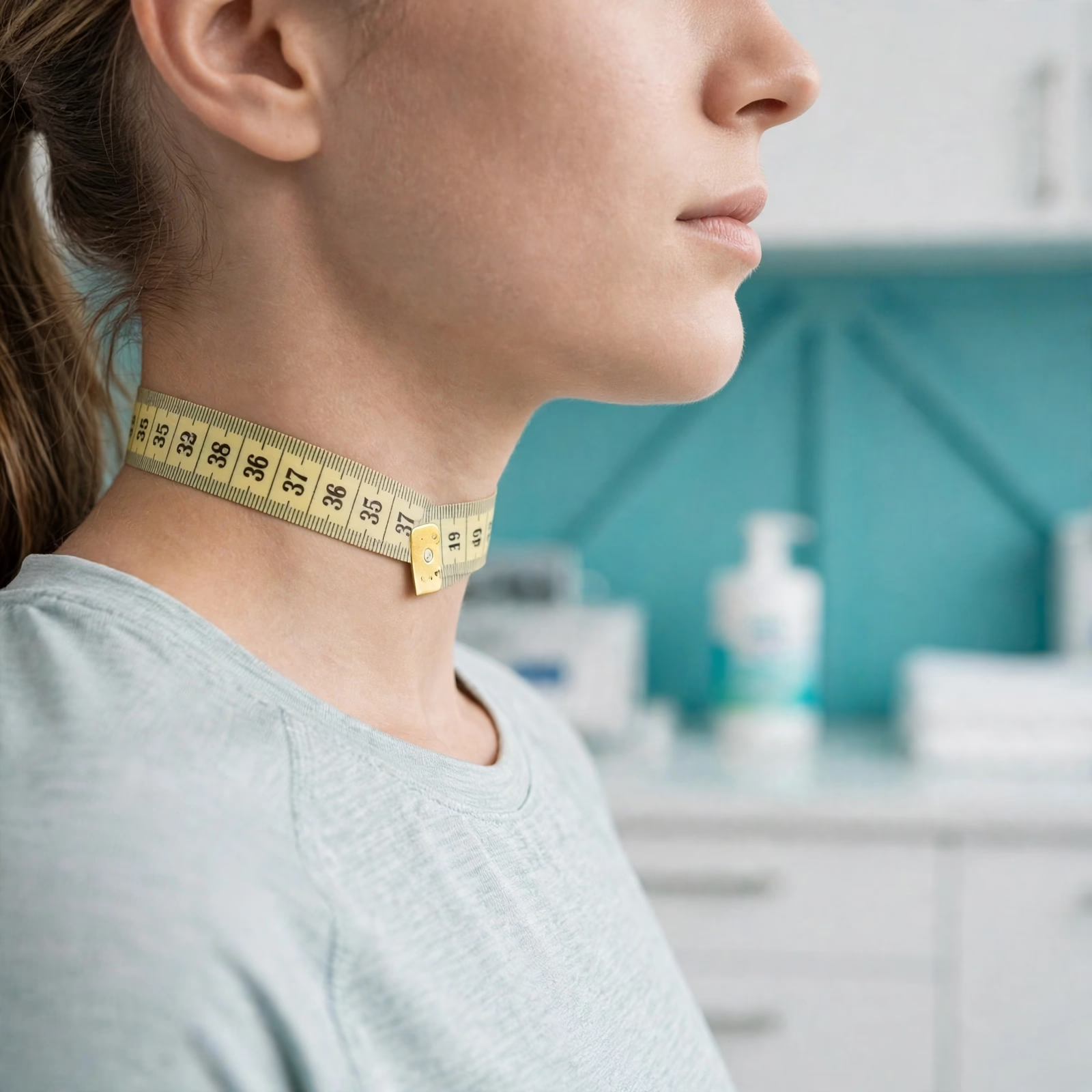
Just below the larynx, the Adam’s apple. Tape level around the neck, snug but not pressing in. Look straight ahead, shoulders down and relaxed.
Waist
Men measure at the navel. Women measure at the narrowest point of the torso, usually just above the navel. Stomach relaxed, at the end of a normal breath out. Do not pull the tape tight to make the number smaller; the formula knows.
Hip, women only
The widest point of the buttocks, feet together, tape level all the way around. This is the measurement that lets the women’s equation see where fat is actually stored.
The US Navy method, explained
The equations were developed in the 1980s by Hodgdon and Beckett at the Naval Health Research Center in San Diego, because the US Navy needed to check the body composition of thousands of personnel without a laboratory. The formulas were fitted against hydrostatic weighing, the reference method of the time, using circumference measurements that predict how much of the body is fat. A thick neck relative to the waist means muscle; a thick waist relative to the neck means fat. The logarithms in the equations are just the maths that turns those ratios into a percentage.
Checked against modern DEXA scans, the Navy method lands within about 3 to 4 percentage points of the scan value for most adults. That is not laboratory precision, and it does not need to be. For tracking your own change over months, a tape measured the same way every time beats a smart scale, whose body fat readings swing with how much water you drank that day. It also beats guessing, which is what most of us do without a number.
Body fat categories (ACE)
These are the American Council on Exercise categories. They are descriptive bands, not pass or fail grades, and women sit higher than men at every level because female essential fat includes sex specific tissue that is not optional.
Women
| Category | Body fat | What it usually means |
|---|---|---|
| Essential fat | 10 to 13% | The minimum for normal hormone function; mostly seen in competitive physique athletes in season |
| Athletes | 14 to 20% | Lean and trained; typical of competitive sportswomen |
| Fitness | 21 to 24% | Fit and sustainable for most active women |
| Average | 25 to 31% | The most common band; health risk depends heavily on the waist |
| Obese | 32% and above | Fat mass high enough to load joints and raise metabolic risk |
Men
| Category | Body fat | What it usually means |
|---|---|---|
| Essential fat | 2 to 5% | The physiological floor; not a target for general health |
| Athletes | 6 to 13% | Lean and trained; typical of competitive sportsmen |
| Fitness | 14 to 17% | Fit and sustainable for most active men |
| Average | 18 to 24% | The most common band; the waist decides most of the risk |
| Obese | 25% and above | Fat mass high enough to load joints and raise metabolic risk |
One caution that matters in South Asia: metabolic risk climbs at lower body fat levels in our population than in the European data these bands were drawn from, much like the BMI cutoffs. If your waist is over half your height, treat an average band result as a reason to act, not to relax.
Body fat percentage vs BMI
BMI sorts people by weight for their height. Body fat percentage sorts them by what that weight is made of. Most of the time the two agree. The disagreements are where the interesting patients live.
The muscular athlete problem
A rugby forward or a serious lifter can post a BMI of 29, one step from the obese line, while carrying 13 percent body fat. BMI calls him overweight because it cannot see muscle. His tape measurements tell the truth in thirty seconds. If you train hard, trust the tape over the chart.
The normal weight obesity problem
The reverse case worries me more. BMI 23, perfectly normal, and body fat of 33 percent: light because there is little muscle, not because there is little fat. Clinicians call it normal weight obesity, and it travels with weak legs, sore knees and rising blood sugar. These patients do not need to lose weight. They need to trade fat for muscle, which is a protein and strength problem, not a starvation problem.
Use both tools the way a clinic does: the BMI calculator as the quick screen, and this page as the follow up whenever the screen and the mirror disagree.
Turn the number into a plan
A body fat result is only useful if it changes what you do next. Protecting lean mass while fat comes off is the whole game: enough protein, strength work your joints tolerate, and a deficit you can live with for months, not days. Both of these tools are free, and protein comes first in each of them:
TDEE Calculator
Your maintenance calories are the base for any fat loss. This works yours out from your age, size and activity level.
Macro Calculator
Once calories are set, protein comes first. This turns your target into daily protein, carb and fat grams, with the formula shown.
Book an assessment
Losing fat with knee or back pain needs a plan your joints can survive. We will build one around your body, not a template.
Start with the TDEE calculator to set your calories, then split them with the macro calculator. Recheck your tape measurements every four weeks; the percentage moves slowly, and that is exactly how it should move.
Body fat calculator: frequently asked questions
How accurate is the US Navy method?
Against DEXA scans and hydrostatic weighing, the Navy equations land within about 3 to 4 percentage points for most adults, which is close enough to track change over time. It beats bathroom scale body fat readings, which swing with hydration, and it costs nothing but a tape. Your own measuring consistency matters more than the formula: same spots, same time of day, tape snug but not digging in.
What is a healthy body fat percentage?
It depends on sex, because women carry essential fat that men do not. Using the ACE categories on this page, the fitness band is 14 to 17 percent for men and 21 to 24 percent for women, and the average band runs to 24 percent for men and 31 percent for women. Athletes sit lower. Chasing the essential fat floor is not healthy for anyone who is not competing under medical supervision.
Where exactly do I measure?
Neck: just below the larynx (the Adam’s apple), tape sloping slightly down toward the front. Waist: at the navel for men, and at the narrowest point of the torso for women, usually just above the navel. Hip, for women: the widest point of the buttocks, feet together. Keep the tape level, snug against the skin, and measure at the end of a normal breath out.
Why does the calculator ask women for a hip measurement?
Because women store a larger share of fat around the hips and thighs, and the men’s equation cannot see it. The women’s formula adds the hip to the waist and subtracts the neck, which tracks how fat is actually distributed in a female body. Leaving the hip out would understate body fat for most women, so the field appears as soon as you select female.
Can body fat percentage be too low?
Yes. Fat is not dead weight; it insulates, cushions joints, stores energy and makes hormones. Below the essential band (under about 3 percent for men and 10 to 13 percent for women), hormone production, immunity and bone health all suffer. In clinic, the very lean patients I worry about are the ones dieting without protein or strength work: they lose muscle along with fat and end up weaker at a lower weight.
My body fat is high but my BMI is normal. Which one is right?
Both are measuring different things, and in that argument the body fat number usually wins. A normal BMI with high body fat is called normal weight obesity: the scale looks fine, but muscle has quietly been replaced by fat, often around the waist. It carries real risk for diabetes and joint pain. This is exactly why this site pairs the two tools: run the BMI calculator for the screening number, then come back here for the composition behind it.
PhysioUBK Health Tools · Estimates only, not medical advice · physioubk.com