
One Rep Max Calculator
Your one rep max is the anchor for every working weight you will ever load on a bar. This calculator estimates it from a set you have already done: enter the weight and the reps, and the Epley formula gives you the headline number while six other proven formulas show you the range around it. You also get the loads that actually matter, the weight for every percentage from 100 down to 50. Strength has to be fuelled, so pair the result with our macro calculator to set the protein target that supports it.

Your estimated 1RM
Epley is the headline. The table under it shows what six other formulas make of the same set. Nothing you type leaves this page.
| Formula | 1RM (kg) |
|---|---|
| Epleyw x (1 + r/30) · headline formula | |
| Brzyckiw x 36/(37 – r) | |
| Landerw x 100/(101.3 – 2.67123r) | |
| Lombardiw x r^0.10 | |
| Mayheww x 100/(52.2 + 41.9 x e^(-0.055r)) | |
| O’Connerw x (1 + 0.025r) | |
| Wathenw x 100/(48.8 + 53.8 x e^(-0.075r)) |
A dash means that formula stops making sense at the reps you entered. The formulas section below explains why.
Your training loads
These working weights are what the estimate is actually for. Each row is a percentage of your Epley one rep max, the load to put on the bar, the reps most lifters can expect at that weight, and what that band is used for. Round the load to the plates you have: finishing a kilogram under is always the better mistake.
| % of 1RM | Load (kg) | Typical reps | Training use |
|---|---|---|---|
| 100% | 1 | Max strength / neural | |
| 95% | 2 | Max strength / neural | |
| 90% | 4 | Max strength / neural | |
| 85% | 6 | Strength | |
| 80% | 8 | Strength | |
| 75% | 10 | Hypertrophy mix | |
| 70% | 12 | Hypertrophy mix | |
| 65% | 16 | Hypertrophy and endurance | |
| 60% | 20 | Hypertrophy and endurance | |
| 55% | 24 | Endurance and warm up | |
| 50% | 30 | Endurance and warm up |
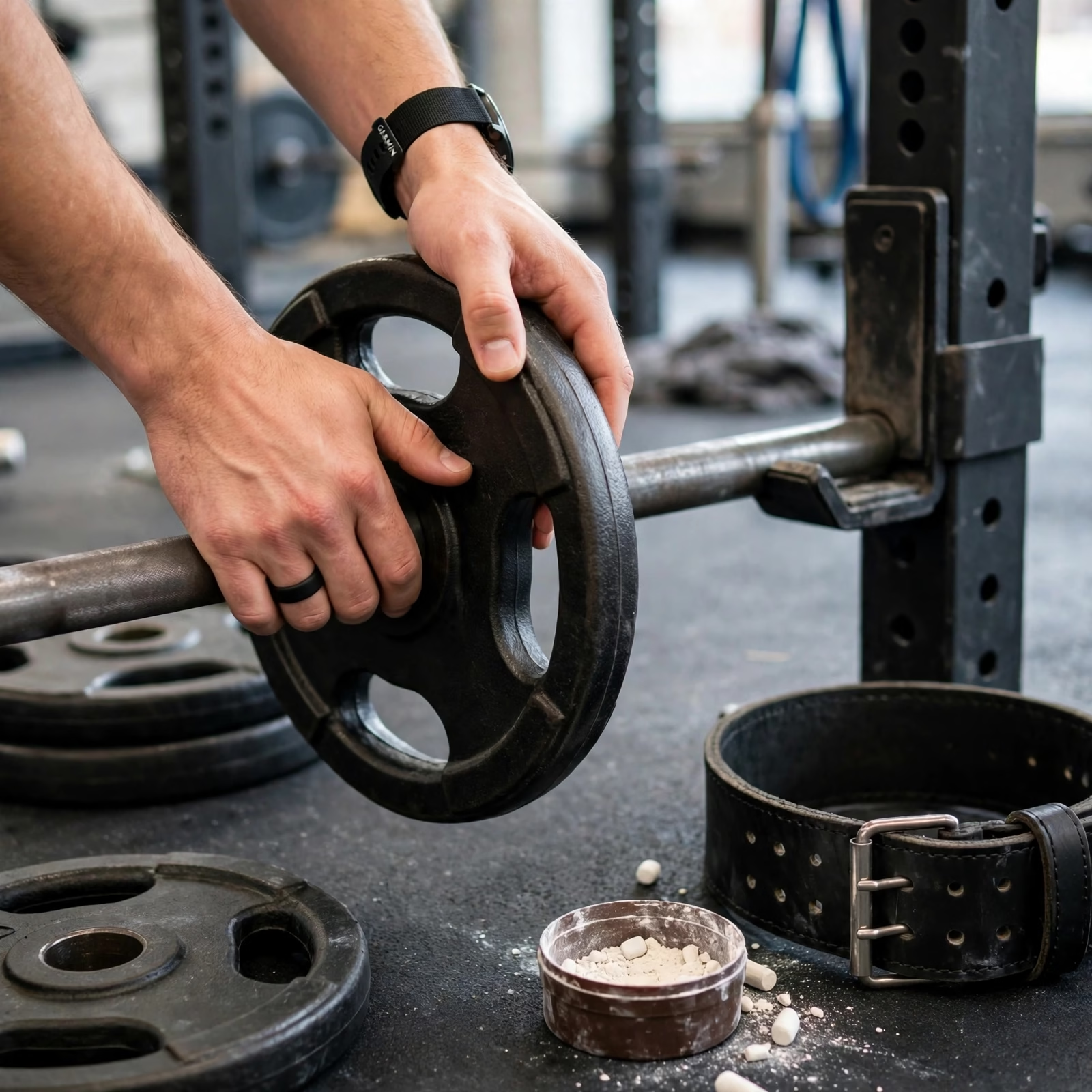
Load the bar from your number, not your mood. If the table says 99 kg for your top set, then 99 kg is the session, whether the gym is watching or not.
The seven formulas, in plain sight
Every formula here does the same job a different way: it watches how many times you lifted a submaximal weight and projects the single you could manage fresh. Each was fitted to a different group of lifters, and each bends the relationship between reps and strength slightly differently, which is why the results table shows all seven instead of hiding the disagreement.
Two honest warnings live inside that list. Brzycki divides by (37 – r), so as reps climb toward 37 the denominator shrinks and the number inflates fast; it was built for low rep sets, and this page caps reps at 30 for good reason. Lander has the same weakness further out. When a formula stops making sense at your reps, its row shows a dash instead of a fantasy number.
How accurate are 1RM estimates?
Under five reps, very accurate. Run a hard triple or a set of five through all seven formulas and they cluster within a few kilograms of each other, because at low reps the reps you managed are mostly a strength signal. That cluster is why I am comfortable prescribing training loads from an estimate, in the gym and in clinic alike.
Above ten reps the formulas drift apart, and by fifteen reps and beyond they can argue with each other by ten kilograms or more on a big lift. The reason is simple: a long set ends for many reasons, only one of which is strength. Your lungs, your tolerance for discomfort, your technique under fatigue and how fresh you were that day all get a vote. Treat any estimate from fifteen reps up as a rough sketch, and retest with a heavier, shorter set if the number really matters.
The lift itself matters too. Lower body lifts like the squat and deadlift involve so much muscle that fatigue muddies high rep sets quickly, while upper body lifts like the bench press track the formulas more predictably at moderate reps. Lifters differ as well: some are wired to grind out reps, others to peak for a single. Note which formula matches your own tested results over time, and trust that one.
How to use your percentages
A one rep max on its own changes nothing. It earns its keep when it sets the weights for the next block of training, and different goals live in different bands of the table.
Strength blocks
Train mainly at 80 to 90 percent, in sets of three to six, for three to five weeks. Add small weight when the top set moves well, and let the percentage table, not one good day, decide the load.
Hypertrophy blocks
Drop to 65 to 80 percent and collect volume: more sets, more total reps, shorter rests. Muscle is built by the work you can recover from, and this band is where most of that work lives.
Deload weeks
Every four to six weeks, take a light week at 50 to 60 percent, or keep the weight and halve the sets. Progress is made in training and banked in recovery; skipping deloads is how plateaus and sore joints get built.
Track progress without maxing out. Once a month, repeat a hard set of three to five reps on your main lift and run it through this calculator again: if the estimate climbed, the training is working. Record the set the same way each time, same lift, same depth, same rest, so the comparison is honest. When the estimate stalls for two months running, change the block, not the formula.
Should you test a true one rep max?
Most of the people I work with should not, and they lose nothing by skipping it. A tested max and an estimated max produce exactly the same training loads. The difference is that the test asks for one all out effort at the precise load where technique is most likely to fold, while the estimate gets its answer from a hard set you were always going to survive. When a patient asks me, my first question is what decision the number would change. It almost never changes one.
If you test anyway, ramp like this
Empty bar, then 50 percent
Five to eight easy reps with the empty bar, then one set of three at about 50 percent of your estimate. Groove the path while the weight still costs nothing.
70 percent, then an 85 single
One or two singles at 70 percent, then one at 85 percent, resting two to three minutes between attempts. From here on, every jump is small and every rep is a single.
Small jumps only
Add 2.5 to 5 percent at a time. The moment a rep slows to a grind or your position shifts, that was your max for today, whether the bar went up or not.
The stop rules
Stop when form breaks down: knees diving in on a squat, hips shooting up early on a deadlift, a back rounding under load. And stop for joint pain, always. Muscle effort burns and fades; joint pain is sharp, local and specific: a pinching shoulder, a hot knee, a back that grabs. Effort is the price of training. Joint pain is information that something is being loaded the wrong way, and no personal record is worth trading for it.
Who should not chase a true 1RM
Skip the test entirely if you are in your first six months of lifting, if your blood pressure is not controlled, if you are returning after surgery or a recent injury, or if you are pregnant. None of these are lifetime bans; they are statements about today. Use the estimate, train the percentages, and rebuild the base that a future test would need.
Why a physiotherapist cares about percentages
In rehabilitation, percentages of a maximum are how load gets prescribed precisely. A tendon programme does not say lift something heavy; it says work at 70 percent this week and 80 the next, so the tissue adapts faster than it complains. Post injury strength work, return to sport progressions and graded loading for painful joints all run on the same maths as the table above. That is why this calculator sits on a physiotherapy site: the percentage table is a clinical tool that gyms happen to share, and it is how people come back stronger than the version of themselves that got hurt.
Build the strength the number promises
An estimate is a plan waiting for fuel and recovery. These free tools close the loop, and they are the same ones I point patients toward when a strength goal lands in the clinic:
Macro Calculator
Strength is built on protein first. This turns your goal into daily protein, carb and fat grams, with the formula shown.
TDEE Calculator
Your maintenance calories decide whether a strength block can actually progress. This works yours out from your age, size and activity level.
Book an assessment
Chasing strength with a sore back or a cranky knee needs loads your joints agree with. We will build the progression around your body, not a template.
Not sure whether the number on the bar or the number on the scale needs attention first? Run the body fat calculator to see what your weight is made of, and the BMI calculator for the quick screening number. Together the four tools give you the full picture: composition, calories, protein and strength.
One rep max calculator: frequently asked questions
What is a one rep max?
Your one rep max, or 1RM, is the heaviest weight you can lift once with good form for a given exercise. It is the reference number that strength training is built on: working weights are set as percentages of it, and progress is measured against it. You do not have to test it directly to use it. A hard set of three to five reps, run through the formulas on this page, estimates it closely enough to plan your training.
Which 1RM formula is most accurate?
For sets of five reps or fewer, the seven formulas on this page usually land within a few kilograms of each other, and Epley, Brzycki and Wathen are all solid picks. Epley is the headline here because it is the most widely used and it behaves sensibly across the rep range most people test. Above ten reps every formula drifts, because endurance starts to matter as much as strength, so treat high rep estimates as rough guides rather than measurements.
How many reps should I use for the estimate?
Three to five hard reps is the sweet spot. The set should end because the weight is genuinely heavy, with one clean rep left in reserve at most, not because you are tired from earlier sets. A single tells you the least, because a true single is the very thing you are trying to avoid testing, and sets above ten reps measure your endurance and your tolerance as much as your strength.
Is testing a true 1RM safe?
For an experienced lifter with healthy joints, a planned max test with a proper warm up ramp and spotters is a normal part of training. For most people it is simply unnecessary risk: the estimate gives you the same planning numbers without the one all out attempt where form breaks down. If you have a recent injury, uncontrolled blood pressure, a surgical repair that is still healing, or less than six months of lifting behind you, do not test a true max. Estimate it, and train the percentages.
What percentage of my 1RM should I train with?
Most strength work lives between 80 and 90 percent, in sets of three to six reps. Muscle building work sits lower, roughly 65 to 80 percent, where you can collect more total reps with good form. Work at 90 percent and above builds top end strength and skill under heavy load, but it costs the most recovery, so it belongs in short blocks, not every week. The training loads table on this page shows the weight and the typical reps for each percentage of your estimate.
Why do the formulas give different numbers?
Because each formula was built from a different group of lifters, on different exercises, and each one bends the reps to strength curve a slightly different way. They agree closely at low reps, where the relationship is simple, and they spread out as reps climb. That spread is honest information: it shows you the estimate is a range, not a single true number. Plan your training from the middle of the range, and let your actual sets tell you which end you live at.
PhysioUBK Health Tools · Estimates only, not medical advice · physioubk.com