
Running Pace Calculator
Pace is the number runners plan by, train by and argue about. Enter a distance and a finish time below, from a race you have run or a target you are chasing, and get your pace per kilometre and per mile, your speed, splits for every kilometre, and predictions from 5K to the marathon. The guide underneath covers training paces, and how to return to running after injury without breaking down.

Your pace
Pace is finish time divided by distance. Nothing you type leaves this page.
| Race distance | Predicted time |
|---|---|
| 5K | |
| 10K | |
| Half Marathon | |
| Marathon |
Predictions use the Riegel formula and assume training matched to the distance. The guide below explains the limits.
Your kilometre splits
A split is the time each kilometre should take at your pace, with the running total beside it. Even splits are the simplest pacing plan there is: check your watch at each marker and keep the numbers boring. This table follows the calculator above and rebuilds as you type.
| Km | Split time | Cumulative time |
|---|
How to use this pace calculator
Three steps, under a minute. You can also work backwards: set a race distance, enter the finish time you want, and read off the pace that goal demands.
Set the distance
Type it in kilometres, miles or metres, or tap a preset for 5K, 10K, the half marathon, the marathon or one mile.
Enter the time
Hours, minutes and seconds: a result you already own, or the finish time you want to test first.
Read pace, splits and predictions
Your pace in both units, a split for every kilometre, and what the same effort predicts at other distances.
Pace vs speed: two views of the same run
Pace and speed are the same information read from opposite ends. Pace is time divided by distance: how long each kilometre takes you. Speed is distance divided by time: how much ground you cover in an hour. A 5:00 per km runner and a 12.0 km/h runner are the same person on the same run.
Runners plan by pace because races are measured in distance, not hours, and a split table only makes sense in pace. Treadmills are set by speed, because the belt moves at a fixed rate. If your treadmill shows only km/h, convert with one division: 60 divided by the speed gives minutes per kilometre. So 10 km/h is 6:00 per km, 12 km/h is 5:00 per km, and 15 km/h is 4:00 per km. Use whichever your plan is written in; this calculator translates.
Race time predictions and the Riegel formula
The predictions above use the formula published by Peter Riegel in the late 1970s, still the standard way to translate one race result into another. Your time grows slightly faster than the distance: double the distance and you more than double the time, because fatigue accumulates. The exponent, 1.06, captures that fade for trained endurance runners.
The formula carries assumptions worth knowing. It assumes you have trained for the target distance: the aerobic base, the long runs, the fuelling practice. A quick 5K does not come with marathon endurance included, so treat long jumps, 5K to marathon above all, as ceilings rather than promises. It also assumes a similar course in similar weather; a hilly marathon in June heat will not match a flat, cool prediction. Predictions are most trustworthy between neighbouring distances, and loosest at the extremes.
Training paces: what each session is for
Most running training is built from a handful of paces, and the honest way to set them is from a recent race, not a pace you wish you owned. Time a hard but controlled 5K, or use a recent result, and the zones below, all described against 5K pace, fall out of it.
| Session | Pace guide | What it is for |
|---|---|---|
| Easy | 60 to 90 sec per km slower than 5K pace | Aerobic base and recovery. Most weekly kilometres live here, at an effort where conversation stays possible. |
| Marathon pace | 30 to 45 sec per km slower than 5K pace | The rhythm of the marathon itself, practised in blocks inside long runs. |
| Tempo (threshold) | 15 to 20 sec per km slower than 5K pace, near 10K pace | Comfortably hard work for 20 to 40 minutes that teaches the body to handle lactate. |
| Intervals (VO2 max) | 5K pace or a touch faster | Repetitions of 3 to 5 minutes with easy jogging between, raising your aerobic ceiling. |
| Repetition | Faster than 5K pace, in 200 to 400 m bursts | Speed and running form, with full recoveries, finished while you still feel strong. |
Treat these as ranges, not commandments. Heat, hills, tiredness and a heavy week all move the right pace for the day, and experienced runners adjust by feel inside the range. If every easy run drifts toward tempo effort, the quality sessions stop being quality: the most common training error I see.
Returning to running after injury
After an injury, the limiting factor is rarely fitness. It is how much load the healing tissue can take today and still recover from by tomorrow. Walk-run intervals solve that problem: the walking breaks cap the total impact while your fitness, which fades far more slowly than tissue tolerance, carries you through.
Start small
Run 1 minute, walk 2 minutes, repeated 8 times: 24 minutes in total, most of it walking. It should feel almost too easy. That is the point.
Build the blocks
Every second or third session, lengthen the run and shorten the walk: 2 run and 2 walk, then 3 and 1.5, then 5 and 1, until you reach 20 to 30 minutes continuous.
Add one thing at a time
First frequency, then duration, then, much later, speed. One quality session a week is plenty for the first month back.
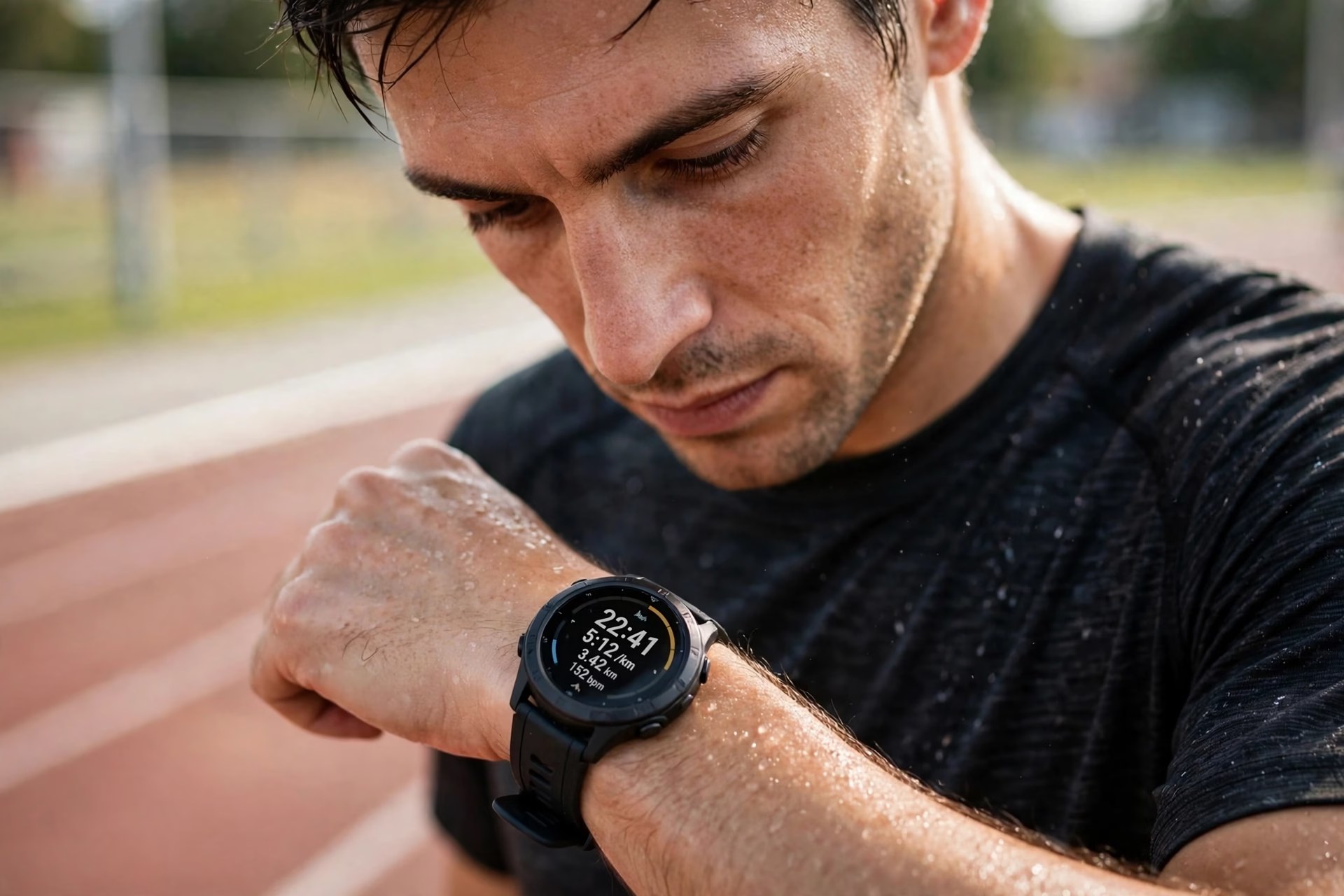
Two rules govern the progression. First, the 10 percent rule: increase total weekly running time by no more than about 10 percent a week. Second, the pain rules. Pain during a run should stay mild, around 3 out of 10 or less, and should settle back to your normal by the next morning. If a joint is worse the morning after, the last step was too big: repeat the previous step instead of pushing on.
Choose flat, even surfaces while you rebuild: a track, a firm trail, a treadmill. Save hills and cambered roads for later. Pain at the front of the knee is the classic returning runner complaint, and our guide to runner’s knee treatment covers the strength work that settles it. Between runs, low impact cardio keeps fitness moving without adding impact.
Plan the running around the run
Pace is one number in a training week. The others live in the PhysioUBK tool set:
TDEE Calculator
Long runs burn real fuel. Your maintenance calories are the base your training diet is built on, and under eating quietly stalls progress.
Macro Calculator
Protein repairs what training breaks down; carbohydrate stocks the long run. This splits your calories into daily grams.
Water Intake Calculator
Sweat losses on a two hour run can pass two litres. Work out your daily target and how hot days raise it.
Book an assessment
Pain that keeps changing your plan deserves eyes on it. Book a 1-on-1 assessment and we will build the return around your body, not a template.
Running pace calculator: frequently asked questions
How do I calculate my running pace?
Divide your finish time by the distance you covered. Run 10 kilometres in 50 minutes and your pace is 50 divided by 10, which is 5 minutes per kilometre, written 5:00 per km. For pace per mile, divide your time by the distance in miles, or multiply your per kilometre pace by 1.609. This calculator does both, and flips the numbers into speed too: the same run is 12.0 km/h.
What is a good running pace for a beginner?
There is no universal good pace: it depends on your fitness, your body and your training history. Most beginners run somewhere between 6:00 and 8:00 per kilometre, and many start with walk-run intervals that average slower than that. The better test is the talk test: at a healthy easy effort you can speak in full sentences. If you cannot finish a sentence, slow down, whatever the watch says. Pace improves as a side effect of consistent weeks.
What pace do I need for a 3 hour marathon?
A 3 hour marathon needs an average pace of 4:16 per kilometre, or 6:52 per mile, held for 42.195 kilometres. Put honestly, that is a high club standard, matching roughly a 39 minute 10K, and it usually takes years of consistent training. It is a fine long term goal, but if you are nowhere near it today, aim at the next milestone down the predictions table and climb one race distance at a time.
How accurate are race time predictions?
The Riegel formula predicts well when the two races are close in distance and you have trained properly for the longer one: within a few percent for most prepared runners. It overpromises when the jump is large, because a fast 5K does not come with marathon endurance, fuelling practice or heat adaptation built in. Treat a 5K to marathon prediction as the ceiling of what the training could produce, not as a promise about race day.
Is it better to train by pace or by feel?
Use both, for different jobs. Easy and recovery runs are best run by feel, using the talk test, because heat, hills, tiredness and a hard week all move the right effort away from any fixed pace. Quality sessions, tempo runs and intervals, are where pace earns its place, holding you at the effort the session was designed for. On very hot days, let feel overrule the watch entirely.
Can I use this calculator for walking?
Yes. The maths does not care how you cover the ground. Enter your walking distance and time and you get your pace per kilometre and per mile the same way. A brisk walking pace is roughly 9:00 to 11:00 per kilometre for most adults, and a purposeful walk at that pace is real exercise, the starting point we use with many patients before running enters the plan.
PhysioUBK Health Tools · Estimates only, not medical advice · physioubk.com