
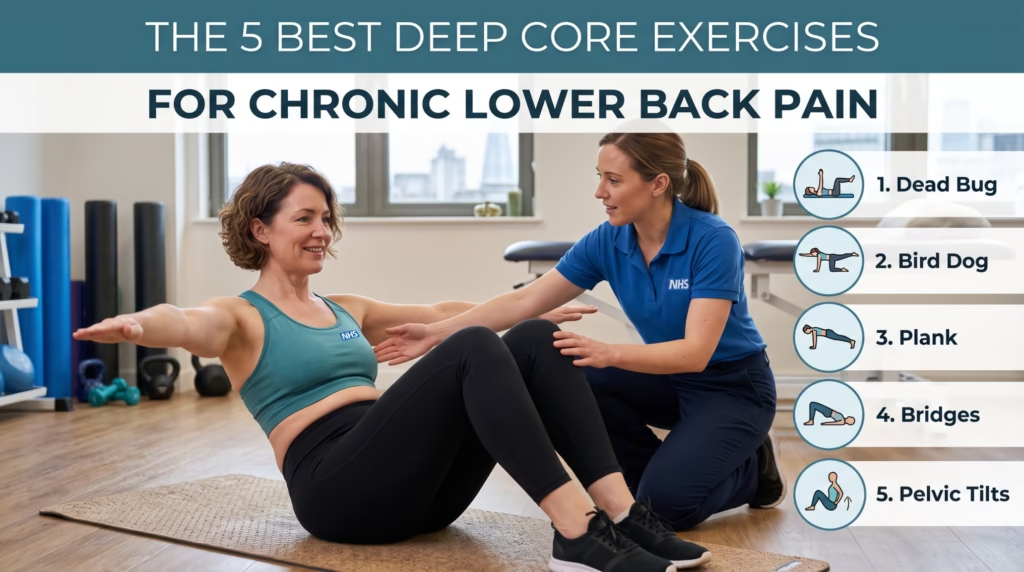
Lower back pain is the leading cause of disability worldwide. Millions of people wake up with a dull, persistent ache in the lumbar region, struggle through desk-bound workdays, and experience sharp, catching twinges when bending over to tie their shoes or lift a grocery bag.
The standard cultural reaction to back pain is often divided into two extremes: complete bed rest or aggressive abdominal training. Both approaches frequently make the condition worse.
When most people decide to “strengthen their core” to fix their lower back, they immediately turn to crunches, sit-ups, and Russian twists. Unfortunately, repetitive spinal flexion and loaded twisting place immense compressive and shear stress on the lumbar intervertebral discs.
True spinal rehabilitation does not require a six-pack. It requires deep core stability, the ability of your inner muscular corset to lock down the lumbar spine, prevent micro-instability, and distribute mechanical loads safely across the body.
Here is an evidence-based clinical guide to understanding the deep core, why traditional ab workouts fail, and the 5 best deep core exercises to resolve chronic lower back pain for good.
The Anatomy of Stability: Superficial vs. Deep Core
To understand how deep core stability eliminates back pain, we must look at the functional anatomy of the human midsection. The abdominal wall is organized into two distinct layers: the global mobilizers and the local stabilizers.
1. Global Mobilizers (The Outer Core)
These are the large, visible superficial muscles, including the rectus abdominis (the “six-pack” muscle) and the external obliques. Their primary purpose is to produce motion, flexing the spine forward, bending sideways, or rotating the trunk. When you perform a standard crunch, you are activating these muscles. While they are important for athletic force generation, they do very little to stabilize individual lumbar vertebrae.
2. Local Stabilizers (The Deep Core Canister)
The deep core acts as an integrated 3D pressure cylinder designed to prevent unwanted motion and protect neural structures:
- Transversus Abdominis (TvA): The deepest abdominal layer. It wraps around your midsection horizontally like a wide weightlifting belt. When contracted, it increases intra-abdominal pressure (IAP) and stiffens the sacroiliac joints and lumbar spine.
- Multifidus: Deep, segmental muscles running along the back of the spine, connecting vertebra to vertebra. They provide localized, segment-by-segment stiffness. In clinical studies, patients with chronic lower back pain almost universally demonstrate atrophy and delayed firing in the multifidus.
- Diaphragm: The roof of the canister. Proper diaphragmatic breathing creates the intra-abdominal pressure necessary to unload the lumbar discs.
- Pelvic Floor Muscles: The base of the canister, working in tandem with the diaphragm and transversus abdominis to support pelvic and spinal alignment.
When the local stabilizers fail to fire on time, the spine experiences micro-instability. The brain senses this threat and commands the large outer back muscles (such as the erector spinae and quadratus lumborum) to seize up in painful, protective spasms. Strengthening the deep inner canister turns off this protective spasm cycle.
Why Crunches and Sit-Ups Worsen Back Pain
Dr. Stuart McGill, a world-renowned spine biomechanics researcher, demonstrated through decades of laboratory research that the lumbar spine has a finite capacity for repetitive flexion cycles under load.
A standard sit-up generates upwards of 3,300 Newtons (approx. 730 lbs) of compressive force onto a fully flexed lumbar spine. Repeated over time, this mechanism pushes the nuclear material of the lumbar discs backward toward spinal nerve roots, aggravating disc bulges, herniations, and facet joint arthritis.
True core training for back pain is anti-movement training. The primary purpose of the core is not to produce motion, but to resist unwanted motion (anti-extension, anti-flexion, and anti-rotation) while your hips and shoulders move freely.
The 5 Best Deep Core Exercises for Chronic Lower Back Pain
These five exercises build multi-planar deep core endurance, restore neuromuscular firing patterns, and maintain a neutral, decompressed spine throughout execution.
1. The Dead Bug (Anti-Extension & Contralateral Coordination)
The Dead Bug is the gold standard for activating the transversus abdominis while retraining cross-body (contralateral) neuromuscular coordination. It teaches your brain to move your limbs independently without allowing the lower back to hyperextend or peel off the floor.
Primary Target Muscles:
- Transversus Abdominis
- Rectus Abdominis (Isometric stabilization)
- Anterior Pelvic Stabilizers
How to Perform It:
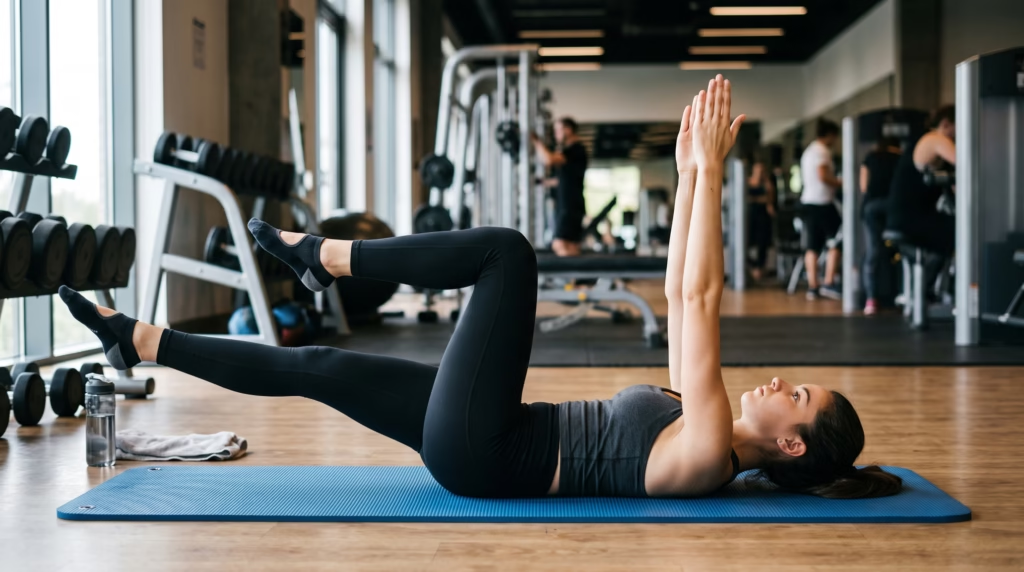
- Lie flat on your back on a firm mat with your arms pointing straight toward the ceiling.
- Lift your legs and bend your knees and hips to 90 degrees (tabletop position).
- The Anchor Cue: Gently draw your belly button toward your spine and flatten your lower back completely against the floor. Imagine there is a $100 bill beneath your lower back that no one can pull away.
- Slowly lower your right arm backward past your head while simultaneously extending your left leg straight out toward the floor.
- Hover your arm and heel 2 to 3 inches above the floor without letting your lower back arch or your ribcage flare upward.
- Exhale slowly through pursed lips as you extend, keeping the deep core braced.
- Return smoothly to the starting position and repeat with the opposite side (left arm, right leg).
Prescription:
- Sets: 3 sets
- Reps: 6 to 8 slow, controlled reps per side
- Key Mistake to Avoid: Arching the lower back when the leg extends. If your back arches, do not lower your leg as close to the floor.
2. The Bird-Dog (Anti-Rotation & Posterior Chain Stiffness)
Part of the legendary McGill “Big Three,” the Bird-Dog trains the multifidus, gluteus maximus, and transversus abdominis simultaneously. It builds posterior stability and teaches the hips to extend without compensating through the lumbar spine.
Primary Target Muscles:
- Lumbar Multifidus
- Gluteus Maximus & Hamstrings
- Transversus Abdominis & Obliques (Anti-rotation)
How to Perform It:
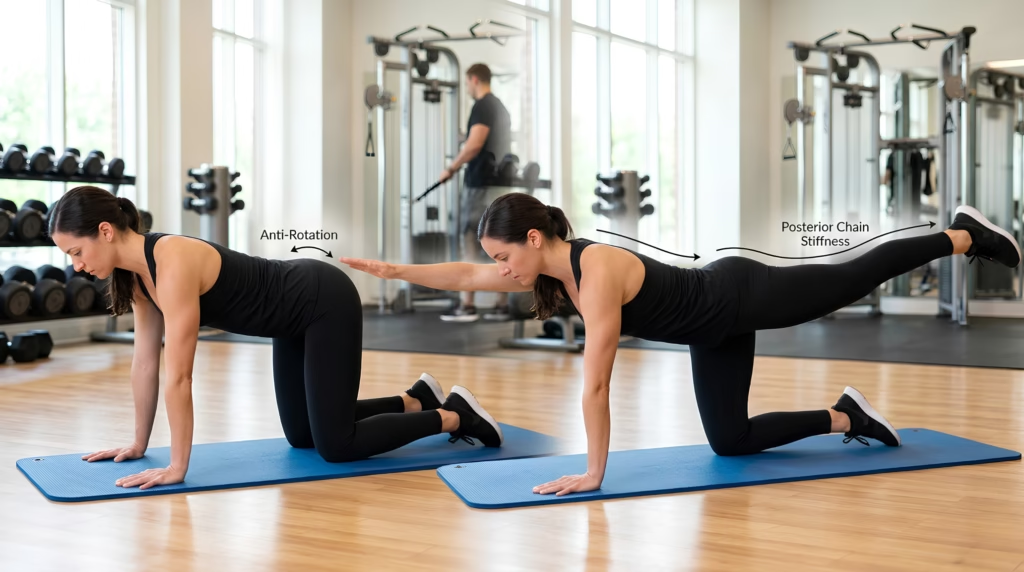
- Start on your hands and knees in a tabletop position. Your hands should be directly below your shoulders, and your knees directly below your hips.
- Establish a neutral spine, do not allow your lower back to sag toward the floor or hump upward.
- Lightly brace your abdominal wall as if preparing for a gentle tap to the stomach.
- Slowly extend your right arm forward at shoulder height while kicking your left leg straight back behind you.
- Focus on driving the left heel straight back (squeezing the glute) rather than kicking high into the air. Kicking too high causes the lower back to hyperextend.
- Imagine balancing a cup of hot water on your lower back throughout the movement; your pelvis must stay completely level.
- Hold the fully extended position for 3 to 5 seconds while breathing smoothly.
- Slowly return to the starting position and switch sides.
Prescription:
- Sets: 3 descending sets (McGill Pyramid: 6 reps, 4 reps, 2 reps per side)
- Hold Duration: 3–5 seconds per rep
- Key Mistake to Avoid: Rotating or tilting the hips to one side. Keep both hip bones pointing directly toward the floor.
3. The Modified Side Plank (Lateral Stability & Quadratus Lumborum)
The side plank is crucial because it strengthens the quadratus lumborum (QL) and internal/external obliques with virtually zero compressive load on the lumbar spine. The QL is a key lateral stabilizer; when it is weak, the spine buckles laterally under load, triggering disc and joint irritation.
The modified (from the knees) variation allows you to build foundational lateral endurance without overloading painful spinal joints.
Primary Target Muscles:
- Quadratus Lumborum
- Internal and External Obliques
- Gluteus Medius (Hip Abductor)
How to Perform It:
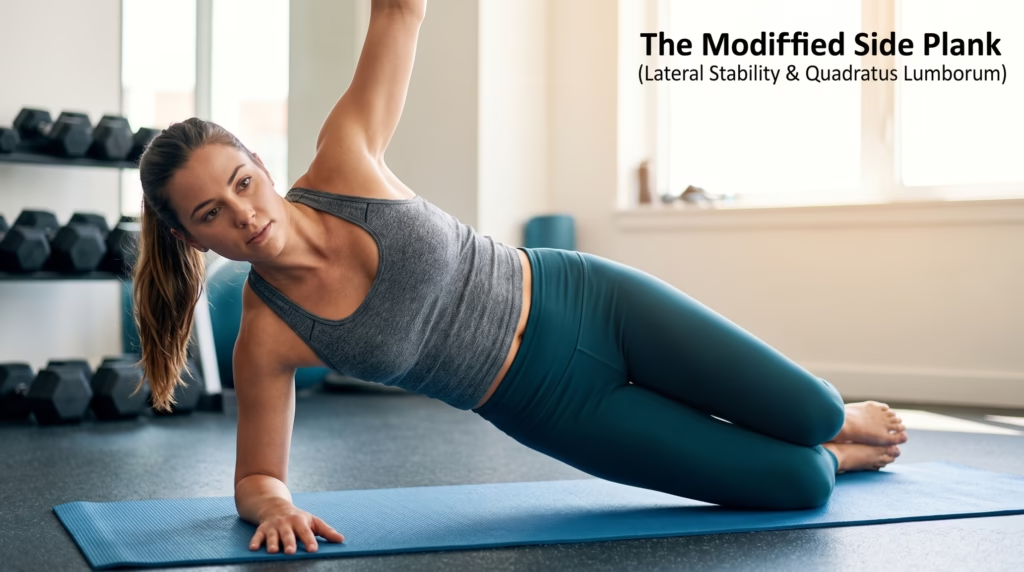
- Lie on your side, propped up on your bottom elbow. Your elbow should be placed directly underneath your shoulder.
- Bend your knees backward at a 90-degree angle, keeping your thighs in a straight line with your torso.
- Place your top hand on your hip or across your chest.
- Press down through your elbow and bottom knee to lift your hips off the floor until your body forms a straight line from your head to your knees.
- Squeeze your bottom glute and lock your core. Keep your neck long and neutral.
- Hold this rigid position while taking slow, controlled breaths.
- Lower your hips with control, rest for 10 seconds, and switch sides.
Prescription:
- Sets: 3 sets per side
- Hold Duration: 10 to 20 seconds per side (build to 30 seconds)
- Key Mistake to Avoid: Sagging through the bottom shoulder or letting the top hip roll forward or backward.
4. The Pallof Press (Anti-Rotation Core Stiffness)
Named after physical therapist John Pallof, this standing anti-rotation exercise trains the deep core to resist twisting forces. In daily life, unexpected twisting forces (such as a dog pulling on a leash, carrying uneven loads, or opening a heavy door) are frequent triggers for acute lower back pain.
The Pallof Press uses a resistance band or cable machine to teach the deep core to lock the spine into neutral alignment while the arms create a long lever arm.
Primary Target Muscles:
- Transversus Abdominis
- Internal and External Obliques
- Rotator Cuff and Scapular Stabilizers
How to Perform It:
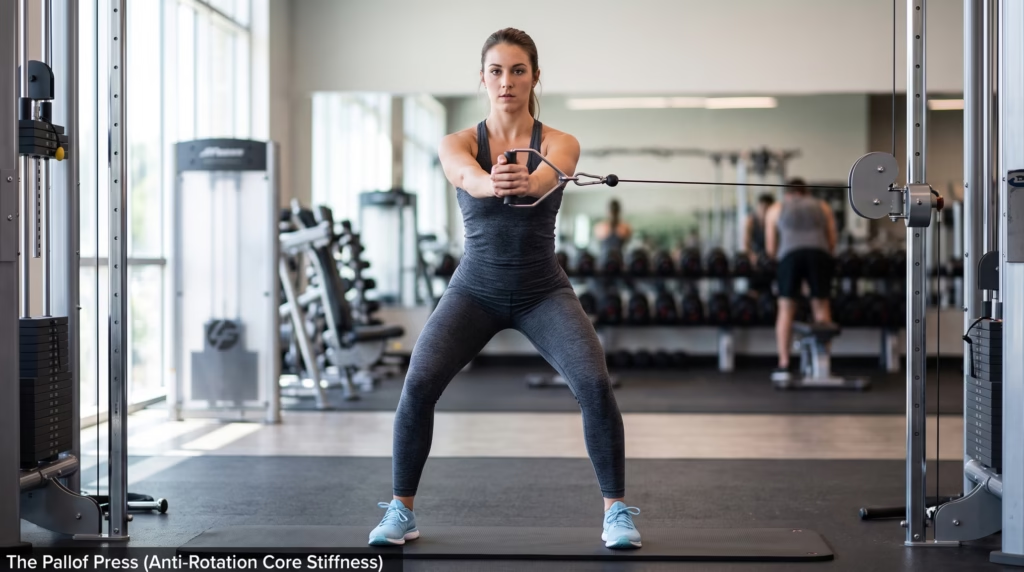
- Anchor a resistance band at chest height to a sturdy post (or use a cable machine).
- Stand perpendicular to the anchor point, holding the band with both hands clasped against the center of your chest.
- Step away from the anchor point until you feel moderate lateral tension trying to twist your torso toward the wall.
- Stand with your feet shoulder-width apart, knees slightly soft, and ribs pulled down.
- Slowly press your hands straight out in front of your chest until your arms are fully extended.
- Resist the pull: The band will attempt to twist your torso toward the anchor. Use your deep core to keep your hands, chest, and hips completely square.
- Hold the extended position for 2 to 3 seconds, then slowly pull your hands back to your chest.
Prescription:
- Sets: 3 sets
- Reps: 8 to 10 slow presses per side
- Key Mistake to Avoid: Locking out the knees or allowing the torso/shoulders to rotate toward the anchor point.
5. Diaphragmatic 90/90 Breathing with Core Bracing
Breathing and core stability are mechanically linked. The diaphragm is both our primary breathing muscle and the mechanical roof of our core cylinder.
Many back pain sufferers are “chest breathers” who overuse neck and upper back muscles while keeping the abdominal wall completely slack. The 90/90 breathing drill resets pelvic alignment, decompresses the lumbar spine, and restores proper intra-abdominal pressure.
Primary Target Muscles:
- Diaphragm
- Transversus Abdominis
- Pelvic Floor
How to Perform It:
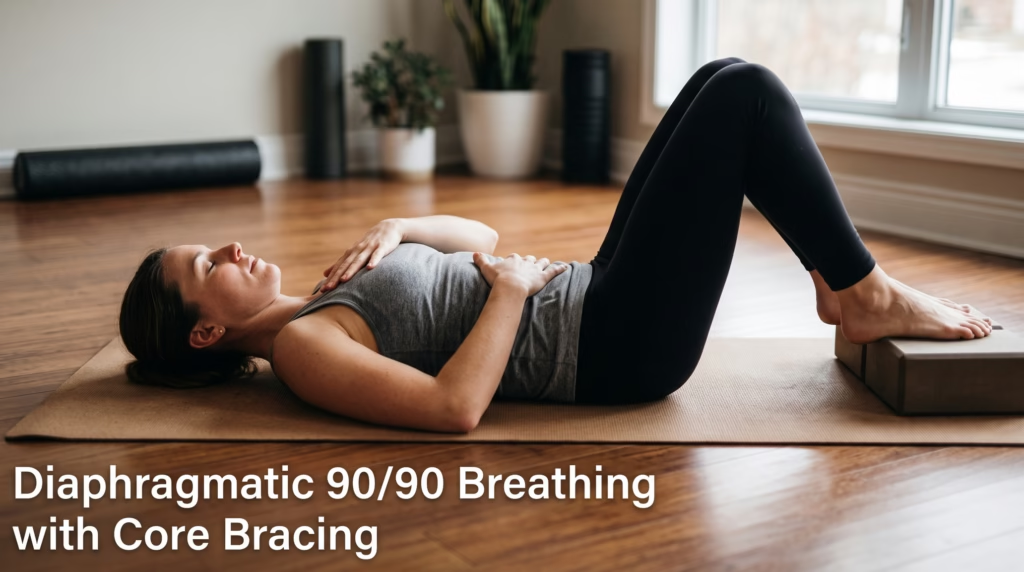
- Lie flat on your back and place your calves and feet on a sturdy chair, couch, or bench so that your hips and knees are bent at 90-degree angles.
- Rest one hand on your chest and one hand on your lower belly.
- Inhale slowly through your nose for 4 seconds, directing the air deep into your lower belly, sides, and lower back (360-degree expansion). Your chest should remain relatively quiet.
- Exhale fully through your mouth for 6 to 8 seconds, feeling your ribcage glide downward.
- At the very end of the exhale, gently tighten your abdominal wall as if zipping up a tight pair of pants (activating the transversus abdominis).
- Hold that gentle brace for 2 seconds, then begin the next nasal inhale into that supported midsection.
Prescription:
- Duration: 3 to 5 minutes daily (ideal as a morning reset or pre-workout warm-up).
- Key Mistake to Avoid: Shrugging the shoulders upward toward the ears during inhalation.
Exercise Progression & Comparison Guide
| Exercise | Primary Biomechanical Role | Target Muscle Focus | Best For | Recommended Volume |
| Dead Bug | Anti-Extension | Transversus Abdominis, Deep Flexors | Eliminating lower back arching, hip dissociation | 3 sets of 6–8 reps/side |
| Bird-Dog | Anti-Rotation & Posterior Chain | Lumbar Multifidus, Glutes | Building segmental spinal stiffness, disc issues | 3 sets (6-4-2 McGill Pyramid) |
| Modified Side Plank | Anti-Lateral Flexion | Quadratus Lumborum, Obliques | Unloading facet joints, lateral spine durability | 3 sets of 10–20 sec holds/side |
| Pallof Press | Dynamic Anti-Rotation | Obliques, Transversus Abdominis | Resisting sudden twisting strains, standing stability | 3 sets of 8–10 reps/side |
| 90/90 Breathing | Intra-Abdominal Pressure | Diaphragm, Pelvic Floor | Calming protective spasms, spinal decompression | 3–5 minutes daily |
Clinical Safety Rules for Back Pain Rehabilitation
When rehabilitating chronic lower back pain, how you execute the movements matters far more than how many repetitions you complete. Follow these non-negotiable safety rules:
- Follow the “Traffic Light” Pain Scale:
- Green (0 to 2/10 Discomfort): Mild muscular effort or stretching. Safe to continue.
- Yellow (3 to 4/10 Ache): Tolerable discomfort that resolves within minutes of stopping. Monitor closely.
- Red (5+/10 or Sharp/Radiating Pain): Sharp, catching pain, or sensations traveling down the leg/numbness. Stop immediately.
- Prioritize Endurance Over Peak Load: The spine is protected by muscular endurance, not maximal single-effort strength. Performing 6 high-quality, perfectly stabilized repetitions provides far more protection than struggling through 20 sloppy repetitions under fatigue.
- Never Train First Thing in the Morning with Heavy Loads: When you sleep, your intervertebral discs absorb fluid and swell via osmotic pressure. For the first 30 to 60 minutes after waking, disc hydrostatic pressure is at its highest. Stick to gentle breathing and walking upon waking; save intense stability training for later in the day.
Expert Consultation & Clinical Care
While these deep core exercises provide profound relief for mechanical lower back pain, chronic symptoms require proper clinical diagnosis. Underlying structural conditions, such as high-grade spondylolisthesis, severe lumbar disc herniations with nerve impingement, or spinal stenosis, require specialized physical therapy supervision.
At Tariq Medicare in Khanewal, Dr. M. Usman Barkat and the PhysioUBK team specialize in comprehensive orthopedic evaluations, spinal biomechanics assessments, and individualized functional rehabilitation programs. If you are struggling with persistent back stiffness, sciatica, or recurring pain episodes, visit our clinic or schedule a consultation online at physioubk.com.
Summary Routine: The 10-Minute Daily Spine Reset
To integrate these movements into your daily life, use this simple sequence 4 to 5 mornings or evenings per week:
- Step 1: 90/90 Diaphragmatic Breathing; 3 Minutes (Decompress and reset)
- Step 2: Dead Bug; 2 Sets of 6 reps per side (Engage front canister)
- Step 3: Bird-Dog; 2 Sets of 5 reps per side with 3-second holds (Engage back canister)
- Step 4: Modified Side Plank; 2 Sets of 15-second holds per side (Lock lateral stabilizers)
By replacing loaded sit-ups and crunches with targeted anti-movement deep core stabilization, you protect your spinal discs, silence muscular spasms, and build a resilient foundation that keeps you moving pain-free for decades to come.
Frequently Asked Questions
Why do sit-ups and crunches make lower back pain worse?
Sit-ups and crunches force the lumbar spine into repeated loaded flexion, generating upwards of 3,300 Newtons of compressive stress on the lumbar intervertebral discs. This repetitive pressure pushes disc material backward toward spinal nerves, aggravating bulges and triggering protective muscular spasms.
What is the difference between the outer core and the deep core?
The outer core (rectus abdominis, external obliques) consists of global mobilizers designed to produce trunk motion like bending and twisting. The deep core (transversus abdominis, lumbar multifidus, diaphragm, and pelvic floor) forms an internal stabilization cylinder designed to prevent micro-movements and protect spinal nerve roots.
How often should I perform these deep core exercises?
Because deep core stability relies on muscular endurance rather than high loads, these exercises are best performed 4 to 5 days per week. A short 10-minute routine consisting of 2 to 3 controlled sets provides optimal neuro-muscular retraining without overloading spinal joints.
Why shouldn’t I do heavy core exercises first thing in the morning?
During sleep, spinal discs naturally absorb fluid and swell, resulting in high hydrostatic disc pressure for the first 30 to 60 minutes after waking. Engaging in loaded core exercises during this window increases disc vulnerability. Gentle walking and breathing drills are safer immediately upon rising.
How do I know if an exercise is safe while recovering from back pain?
Follow the traffic light rule: mild muscular effort or stretch (0–2/10 pain) is safe. A manageable ache that settles quickly (3–4/10) should be monitored. Any sharp, catching pain or radiating nerve symptoms down the legs (5+/10) is a red light and requires you to stop immediately.

Is Your Office Chair Causing Your Back Pain?
It’s 5 PM. You’ve been at your desk since 9, and your lower back is…

5 Morning Stretches for a Stiff Back: A 10-Minute Routine
You swing your legs out of bed, stand up — and your back feels like…
What is a Functional Capacity Evaluation (FCE) in Physical Therapy?
CLINICAL GUIDE & ASSESSMENT PROTOCOL An exhaustive, clinician-reviewed guide explaining the protocols, physical tolerance metrics,…

Losing Muscle, Losing Protection? The Surprising Link Between Muscle Strength and Immunity
When most people think of the immune system, they picture white blood cells, lymph nodes,…
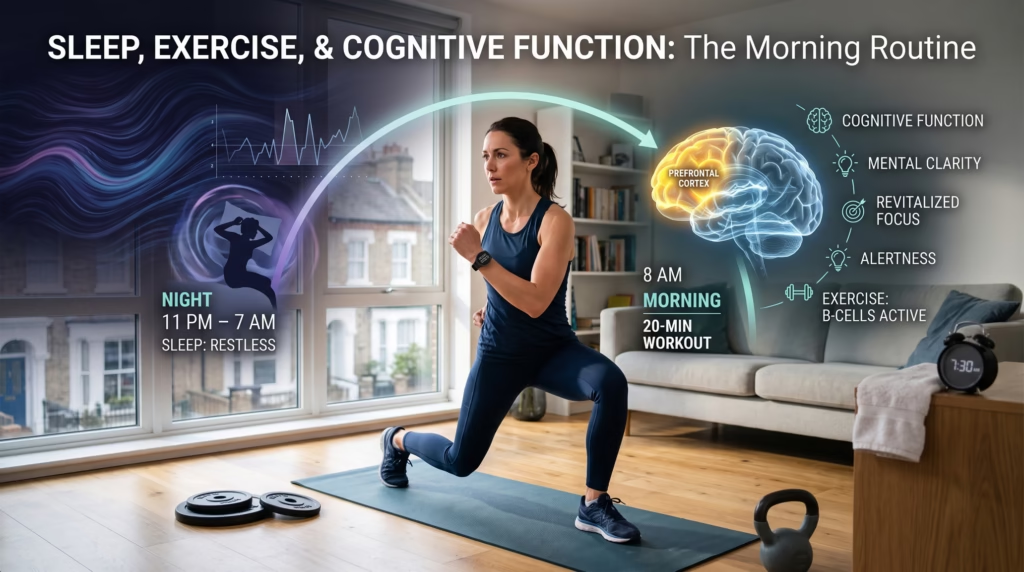
Sleep Better, Think Better: Can a 20-Minute Workout Undo a Sleepless Night?
Waking up after a sleepless night of tossing and turning feels like trying to operate…
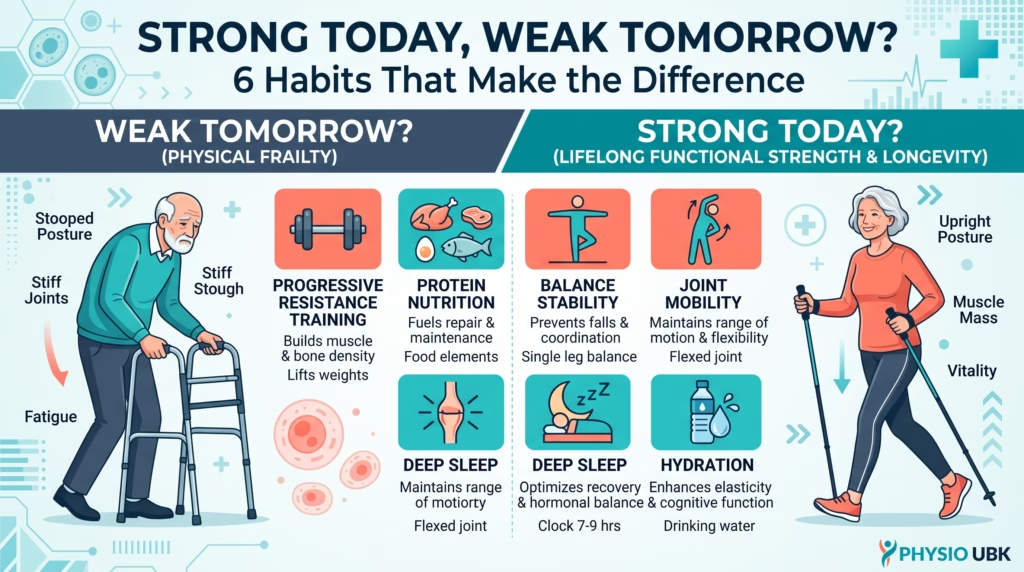
Strong Today, Weak Tomorrow? 6 Habits That Make the Difference
Physical strength often feels permanent when we have it. When you can effortlessly carry heavy…
As someone who has struggled with chronic lower back pain for a while, I can’t stress enough how much proper core work helps. Dead bugs and bird-dogs have been complete game-changers for my routine. Thanks for putting together such a clear and helpful guide!